
February 24, 2026 · 4 min read
A Non-Developer CFO's First 4 Weeks With Claude Code
I'm a fractional CFO who doesn't write code. Four weeks with Claude Code changed my whole workflow: 7 years of DATEV exports into a SQL database, financial reports on demand, five real projects. What worked and where it failed.
I'm a fractional CFO. I help tech companies with 30 to 500 employees run their finance operations better, and I don't write code. My tools were always Excel, PowerPoint, and a BI dashboard someone else had built. Then I started using Claude Code, Anthropic's command-line agent that works directly on your machine and your real files. Four weeks later my whole workflow had changed.
Can a non-developer actually use Claude Code?
Yes, and that was the surprise. I came to it out of curiosity rather than strategy: it kept showing up in my feed and I did not really understand it until I started. Within four weeks it had replaced most of how I worked.
What makes Claude Code different from ChatGPT or Claude.ai?
It works directly in your local folders and files, so there is no upload-process-download loop and no black box. With the browser tools I was forever uploading files, copying results back, and downloading outputs, never quite able to see what happened inside. With Claude Code I handed it CSV files of financial data, said "transform this and load it into a SQL database," and it did exactly that, locally, with every file and step visible. That was the moment it stopped feeling like a chatbot.
What did I actually build in 4 weeks?
Five real projects, with the usage to back it up: 548 messages across 88 sessions, 15 active days, 25,966 lines of code, 474 files touched, and 75 git commits.
- A GDPdU/DATEV converter (~25 sessions): a TypeScript and React app that imports, converts, and analyzes German tax-audit data. The data now flows into a SQL database instead of into Excel files I maintained by hand.
- A vacation-rental website (~15 sessions): SEO, Google Rich Results validation, analytics, and Vercel deployments, refined until all eight structured-data items passed with zero errors.
- Workspace optimization (~15 sessions): documentation frameworks and project organization across seven repositories.
- Financial reporting features (~8 sessions): trial-balance reports with multi-year support, correct P&L and balance-sheet sign conventions, HGB taxonomy sorting, and drill-down to journal entries.
- Testing and DevOps (~5 sessions): unit tests across three projects and deployment workflows.
The breakthrough: 7 years of DATEV exports into a SQL database
If you are a startup CFO in Germany you know the pain: DATEV exports are built for compliance, not management, so every month you clean and restructure data in Excel just to get a basic P&L.
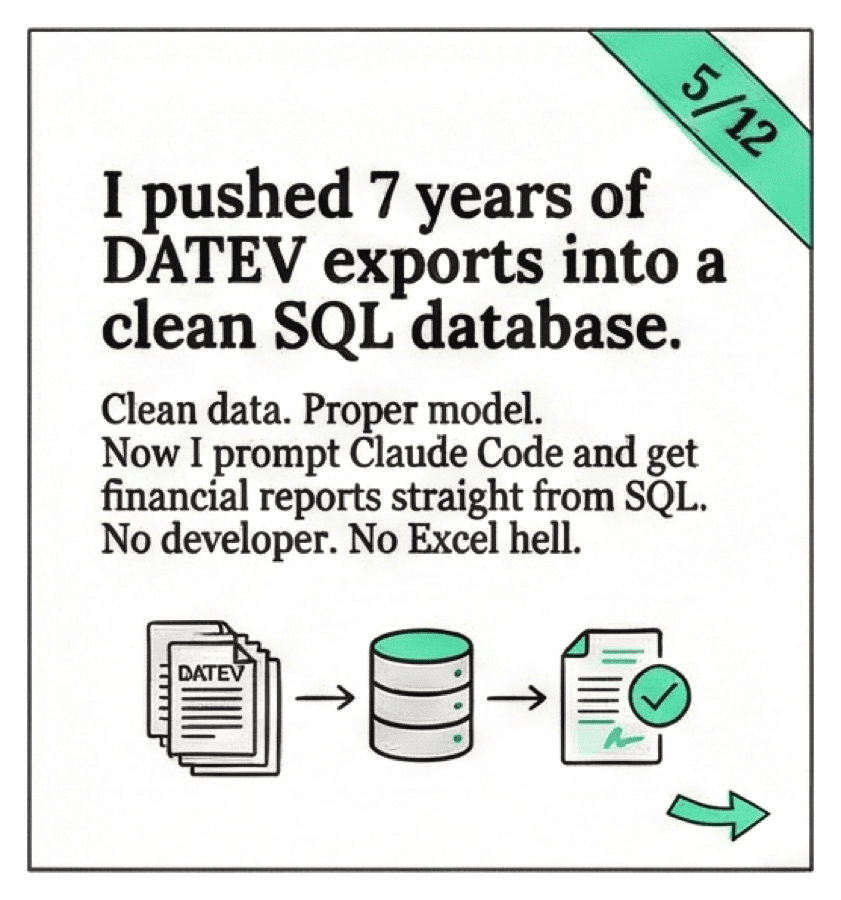
I pointed Claude Code at seven years of raw exports, with cryptic column names and several file formats, and asked for a data model I could analyze. I got a working SQL schema, all data imported and normalized, proper relationships between accounts and periods, trial-balance reports with multi-year comparisons, and drill-down from a summary to individual journal entries. From messy exports to a finance analytics platform, measured in sessions rather than weeks.
Is it really just about writing code?
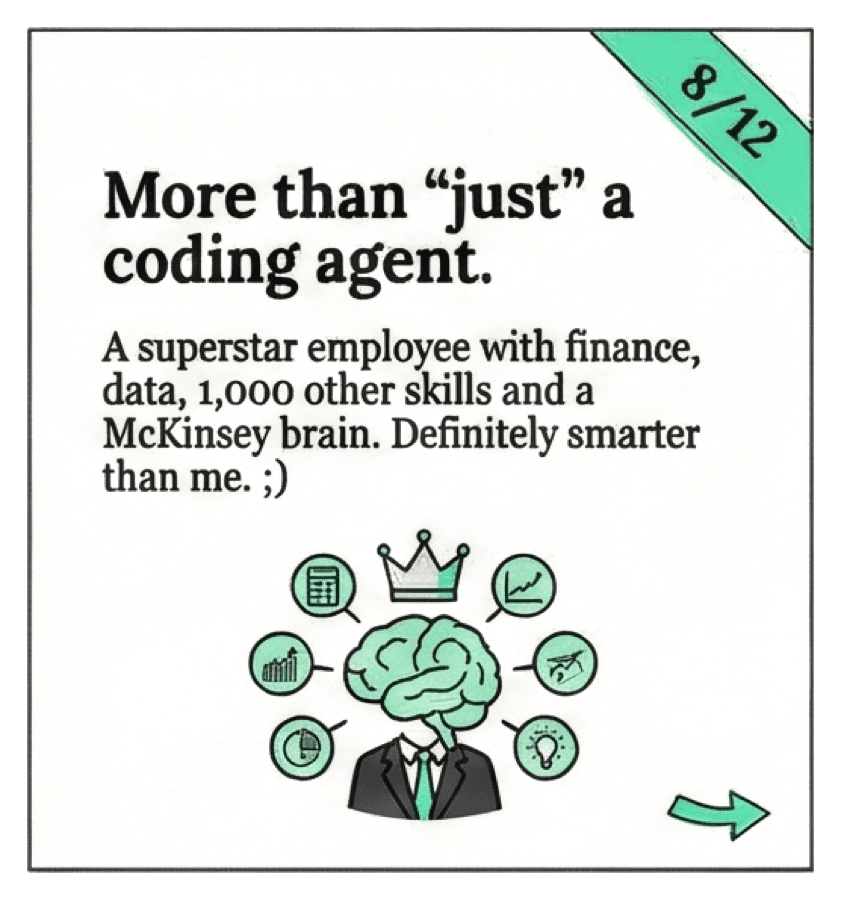
No. Within a few hours it had become my planner, task tracker, deployment tool, database manager, and research assistant all at once. It replaced five or six separate tools (a browser chatbot for thinking, Notion for planning, a tracker, Excel, a database client, an editor), and I now spend about 70% of my working day in it. It thinks, tracks, connects, and executes, the way a capable employee would.
Where does Claude Code fail?
It is not all smooth, and the honest list matters. It picked the wrong technical approach on the first try about 18 times; the trial-balance report needed a full refactor after it built the wrong columns. I also had to correct misread intent about 8 times, usually when I used non-technical language. Bugs were often fixed at the surface while a deeper cause remained, so a few features needed two rounds. And the learning curve is real: the first week was rough, because directing an agent is a different skill than chatting with one.
Why does this matter for finance leaders?
Finance teams are increasingly expected to behave like data teams: to forecast, automate, and turn numbers into decisions. Most of us understand the business logic but lack the technical skills to build the tools ourselves. Claude Code closes that gap. Developers still matter; this simply gives finance leaders a direct way to build the reports and automations they need, turning raw accounting exports into clean insights in a session instead of a month.
How do I start?
Install it and use it. You will not get the "this is genuinely different" moment until you do. The first week takes patience, but four weeks in I would not go back.
If you want a faster start, an AI Power Hour is one way in: we take one of your real finance problems and build the automation together in 60 minutes.
Frequently asked questions
Do I need to know how to code to use Claude Code?
No. I do not write code and never have. You direct the agent in plain language, approve its plan, and it executes. The skill is describing what you want clearly, not programming.
What can a CFO actually use Claude Code for?
Converting messy exports like DATEV into a clean SQL database, building financial reports on demand, automating spreadsheet work, and prototyping internal tools without hiring a developer.
How steep is the learning curve?
Real. The first week is rough, because you are directing an agent rather than chatting with one. Budget time to learn the workflow; it is an investment, not a shortcut.
How is Claude Code different from ChatGPT or Claude.ai?
It runs on your machine in your actual files, makes coordinated changes across many files at once, and executes work such as commits, deployments and database queries instead of only advising.